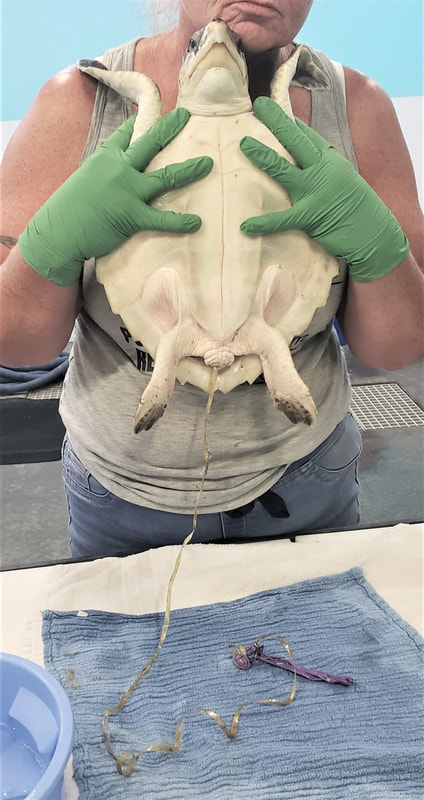
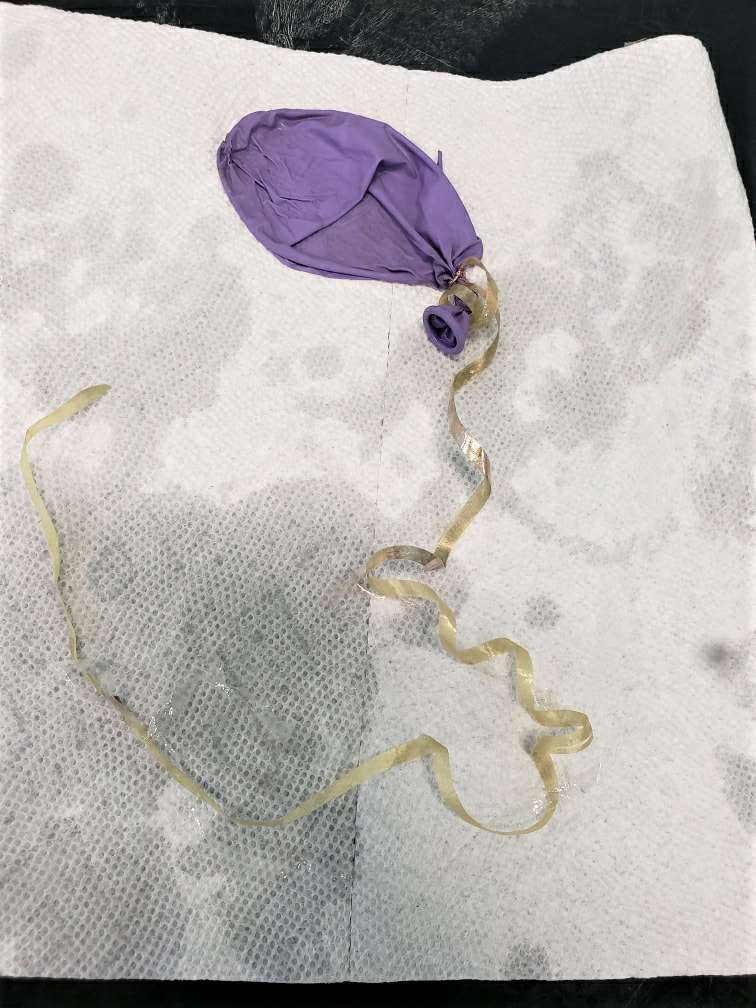
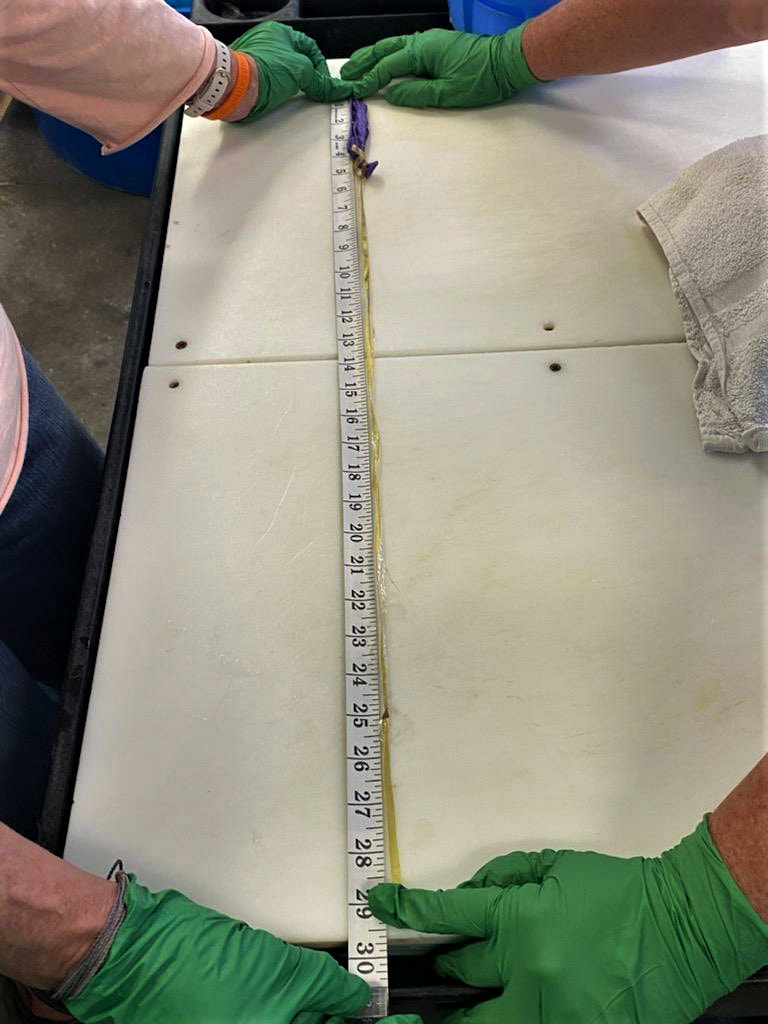
 By Karen Sota It’s been a busy summer with patients of various sizes and species cycling through our hospital. Many of them have been incidental catches from coastal waters and depending on where, or how many hooks were involved they’ve been short-timers ready to go home after a few days of TLC and breakfast. When a small Kemp’s arrived from Oak Island with a hook in her mouth we thought, dang, another one. Our Director, Kathy Z., easily removed the hook, but “Limeapalooza” looked to be in a bit worse shape than the other turtles who had come and gone. She was on the thin side and dehydrated. She was given subcutaneous fluids and then housed in a tank with lower salinity containing more fresh water than we normally use for our turtles. The water with less salt would be absorbed through her skin and help restore her blood chemistry values to more typical levels. But even after she “plumped up” following hydration therapy she was still too skinny for us to feel comfortable about sending her home too quickly. Limeapalooza’s initial breakfast was a healthy portion of fish and squid, but typical of our Kemp’s she let us know very quickly that fish was “icky” and only squid was an acceptable menu item. They have a way of training us. So, squid it is, and she was eating like a champ. And after three days she had a surprise for us. This gal was enjoying her daily swim in the therapy pool when our staff noticed something trailing behind her, something purple. Her swim was rudely interrupted and when she was brought out for an exam it was obvious that all that squid had been effective in moving a balloon, with ribbon, through her tiny digestive tract. If ever our visitors who happened to be there that day wondered where ocean trash goes they got an up-close, very up-close answer. Limeapalooza had her butt exposed to the crowd while Kathy gently tugged to extract as much of this garbage as she could. When she encountered some resistance, the ribbon was cut and taped to Limeaplooza’s carapace to prevent what was coming next from getting tangled. Limeapalooza was served a second helping of squid rings and was moved to a larger tank where more activity would help the remainder of the ribbon pass through without problems. At the end (literally) the balloon and ribbon measured around thirty inches. In the ocean that balloon looked like her favorite food, so she ate it. It might be the reason she was underweight; she didn’t feel hungry because she had a gut full of trash. If it had not passed that little gal may have never eaten again and starved to death. Balloons might be pretty floating through the air. But they eventually land and can be deadly to wildlife. There are other ways to celebrate.
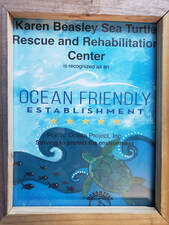 Our hospital has been officially awarded certification as an Ocean Friendly Establishment (OFE). OFEs commit to eco-conscience practices and must demonstrate at least one major way of reducing single-use plastics. We do not offer water and other beverages in plastic bottles and our drinking fountains dispense filtered water for refilling reusable containers. We long ago eliminated plastic bags and Styrofoam for gift shop purchases; we recycle everything that is allowable. Water in Sea Turtle Bay is cleaned and recirculated back to the tanks, and our hospital volunteers participate in beach clean-ups. Topsail Turtle Project volunteers consistently carry a bag to pick up beach trash during their morning walks. And we have a large display in our education hall showing ways that plastic affects all living creatures. We are proud to display our certification seal and encourage you to support the OFEs in our coastal communities. Visit https://www.oceanfriendlyest.com/ for a list of participants. We’re getting into cross-over season on the beach. The mamas are still arriving to nest but some of our earlier nests are getting close to hatching. We can’t tell you where or when it will happen. Those little critters come out when they’re good and ready and we don’t get advance notice. It’s a matter of luck to be there for a boil. If you spot a nesting mama, see hatchlings emerging, or see anything unusual such as an injured or stranded turtle please call our Director of Beach Operations, Terry Meyer at: 910-470-2880. If she is not available, you may call the hospital during operating hours: 910-329-0222 . We will take the information and we will send a trained volunteer to meet you to assess the situation. The State of NC hotline for stranded, sick, and injured turtles is 252-241-7367. The state number picks up 24/7. Please note that all our work with sea turtles, at the hospital and on the beach, is authorized by the NC Wildlife Resources Commission, ES Permit 22ST05.
Our public tour schedule through the month of July is Mon – Fri, Noon-4; Saturday, 10-2, and Sunday Noon-2. Tickets MUST be purchased in advance through the Visit page on our website. Select the date, time and the number of guests in your party and purchase your tickets. We limit the number of guests for each time to make the experience more enjoyable and safer as we still contend with Covid. Sorry, but we are not able to accommodate walk-ups for tours once we sell out for the day. Please note that if our surrounding counties experience an increase in Covid cases we may require masks for everyone over the age of three, no exceptions. Check the website for current masking requirements when buying your tickets. Please keep in mind that summer traffic can be very heavy, especially on the weekends so plan your arrival accordingly. If you are coming only to our gift shop (not for a tour) you can enter through the single door to the left of the main entrance.
0 Comments
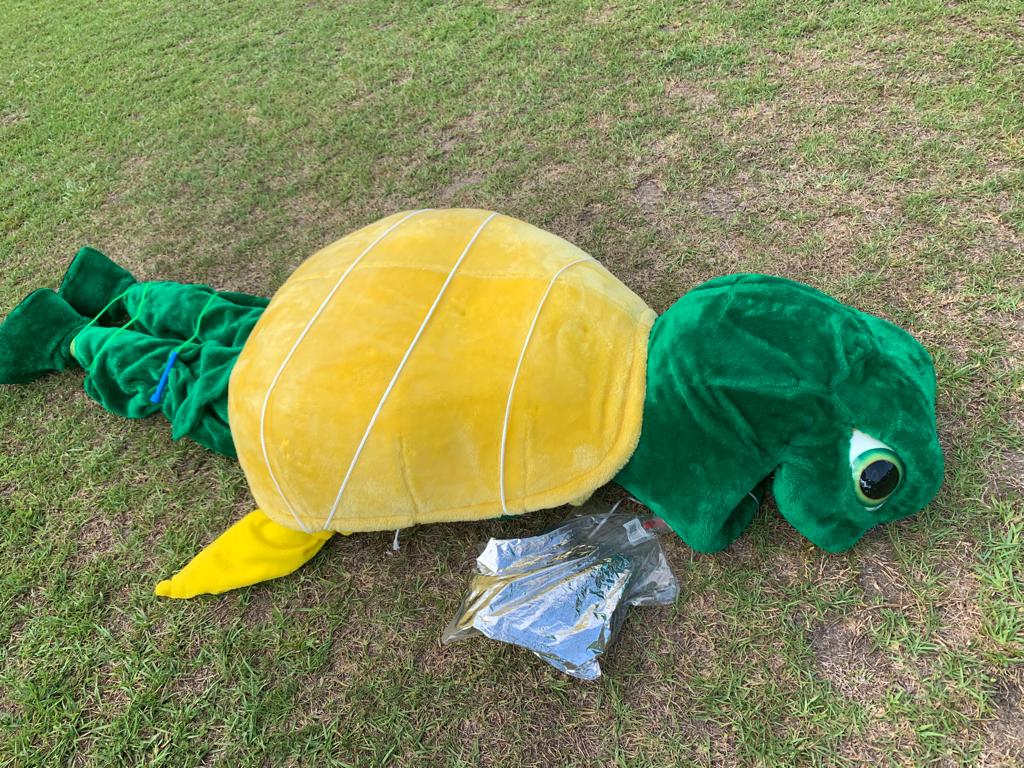
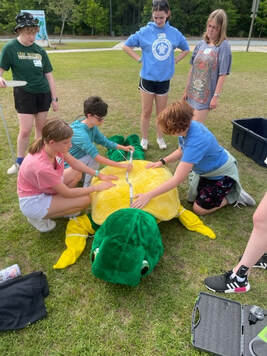
By Karen Sota Our regular staff always looks forward to a bit of a break during the summer when our college interns arrive for their twelve week program. This year has them hopping, not only with turtle care, nesting activity and tours every day but also working with the kids from Sea Turtle Camp, based in Wilmington. This concept of an immersive program to learn about sea turtles was the creation and collaboration of Jen Civelli, a long-time hospital volunteer and our founder Jean Beasley. Students work alongside and under the supervision of our interns to learn what it takes to care for, rehabilitate, and release one of these magnificent creatures back to the sea. Campers learn to know the turtles by name and begin to recognize the distinct species and personalities exhibited by each turtle. Lots of hands-on with our patients, but also some classroom type of work. And this year our interns have cooked up something pretty stimulating for their two days with us. On the first day our interns use a plush turtle to introduce the stranding report. This intake form is completed by the individual responding to the stranding and the information is often supplemented when the turtle arrives at our facility. Information includes date and location of the strand, weight and measurements, species and any identifying tags or markings. Injuries and the general condition of the turtle is also noted. Using calipers and other tools of the trade the campers learn how to complete the form which becomes a permanent part of the patient’s file. A copy is forwarded to North Carolina Wildlife Resources Commission for aggregate date collection on North Carolina sea turtle activity. On day two the students are informed that we have received a call reporting a turtle stranding, and they are all going along for the recovery! They are loaded into our hospital van with the typical recovery items (tank, towels) and driven to…the front of our building. But wait, there is a stranded turtle out there. They need to get to him quickly because one, he’s all tangled up in fishing gear and may have swallowed a balloon, and two, it’s intern Michael in our furry mascot suit and he really does need rescuing. Like now. Students rush over to this poor critter, gently untangling him and hoisting him onto one of the transport carts we use at the hospital. The victim is wheeled into the hospital where the students complete the stranding report, noting all the required information. It looks like this turtle is basically in good shape and thankfully hasn’t been out in the sun too long. Last step is releasing turtle Michael (from his turtle suit) back into the wilds of our hospital. Pretty creative and engaging way to have kids learn about the rescue part of our work.
We’re well into what just might be a great nesting season with 67 at this writing and almost two months to go. If you spot a nesting mama, or anything unusual such as an injured or stranded turtle please call our Director of Beach Operations, Terry Meyer at: 910-470-2880. If she is not available, you may call the hospital during operating hours: 910- 329-0222 . We will take the information and we will send a trained volunteer to meet you to assess the situation. The State of NC hotline for stranded, sick, and injured turtles is 252-241-7367. The state number picks up 24/7. Please note that all our work with sea turtles, at the hospital and on the beach, is authorized by the NC Wildlife Resources Commission, ES Permit 22ST05. Our public tour schedule through the month of July is Mon – Fri, Noon-4; Saturday,10-2, and Sunday Noon-2. Tickets MUST be purchased in advance through the Visit page on our website. Select the date, time and the number of guests in your party and purchase your tickets. We limit the number of guests for each time to make the experience more enjoyable. Sorry, but we are not able to accommodate walk-ups for tours once we sell out for the day. Please keep in mind that summer traffic can be very heavy, especially on the weekends so plan your arrival accordingly. If you are coming only to our gift shop (not for a tour) you can enter through the single door to the left of the main entrance. by Karen Sota  Tuesday June 14th was homecoming, or more accurately, home-going for ten rehabilitated sea turtles: one loggerhead, two Kemp’s and seven greens. Nine of these critters were victims of cold stunning, Kemp’s “Magic Potion” being the exception. His decision to choose a quick snack on a baited hook landed him in our hospital for a month. This was our first public release for the year and sea turtles can certainly draw a crowd. Despite the forecast for extreme heat and humidity, it looked like nearly one-thousand people managed to make their way to the beach and hang in there until the last turtle powered through the surf. The smaller turtles were brought down to the shoreline in their transport tubs and then carried by our volunteers slowly up and down the exceptionally long lines seeming to enjoy the oohs and ahhs of their adoring fans and striking poses for photo ops. We’ve learned over the years that some of them are just hams when they see a camera. “Sea Glass” one of the larger juvenile greens got a ride strapped down on our special “turtle taxi” because she’s, well, kinda crazy. Our larger turtle taxi hauled loggerhead “Burnt Sienna” who tipped the scales close to one-hundred-twenty pounds down to the surf. Once they hit the water only a sandbar close to shore slowed them down, for just a few seconds. They were gone with barely a wave of and flipper for a final goodbye. Even though ten turtles have left the building there are still patients who are waiting for you to visit, including permanent resident and hospital ambassador “Lennie” and crowd favorite Jersey girl “Snooki.” Our senior interns are giving our regular staff a bit of a break for summer and are very enthusiastic about their twelve weeks with us. You’ll be meeting most of them during your visit and we “regulars” always hope our guests can come up with a question or two that makes them do some research or must ask one of us old-timers for help in answering. We’ve added another hour to our tour to accommodate the overwhelming request for tickets. As of now we will be open from Noon – 4 PM though July. Nesting season on the island is in full swing with (number to come) nests at this writing. There’s no way to predict when or where a mama turtle will come ashore so if you happen to be here when she does consider yourself incredibly lucky. Please respect mom and the exhausting process by maintaining your distance and not using flashlights or flash photography to distract her. If you spot a nesting mama, or anything unusual such as an injured or stranded turtle please call our Director of Beach Operations, Terry Meyer at: 910-470-2880. If she is not available, you may call the hospital during operating hours: 910-329-0222 . We will take the information and we will send a trained volunteer to meet you to assess the situation. The State of NC hotline for stranded, sick, and injured turtles is 252-241-7367. The state number picks up 24/7. Please note that all our work with sea turtles, at the hospital and on the beach, is authorized by the NC Wildlife Resources Commission, ES Permit 22ST05. Again, through June and July we will be open seven days a week: Mon – Fri, Noon-4; Saturday,102, and Sunday Noon-2. Tickets MUST be purchased in advance through the reservations page on our website. Select the date, time and the number of guests in your party and purchase your tickets. We limit the number of guests for each time to make the experience more enjoyable and to continue our commitment to keep you and our staff safe as we continue to respond to any changes in Covid. At this point masks are not required. Sorry, but we are not able to accommodate walk-ups for tours once we sell out for the day. Please keep in mind that summer traffic can be very heavy, especially on the weekends so plan your arrival accordingly. If you are coming only to our gift shop (not for a tour) you can enter through the single door to the left of the main entrance.   by Karen Sota We talk to our turtles all the time, and they generally respond to the sound of our voices. In all honesty they’re probably only paying attention to us because they think we’re there to deliver a meal. But what can turtles really hear, especially underwater where they do most of their hearing? Since last year some of our patients have been participating in non-invasive research to find answers to that very question. The project is being conducted by our turtle vet, Dr. Craig Harms along with Charles Muirhead PhD student (Duke) and Wendy Dow Piniak, PhD (NOAA) with funding from the Bureau of Ocean Energy Management (BOEM.) The ocean is a noisy place with naturally occurring sounds including storms and hurricanes. But there’s also a lot of people noise from commercial, recreational and military activity. Our proximity to Camp Lejeune has desensitized us locals to the “sounds of freedom” but how are sea turtles responding to Coast Guard boats, ordnance and low flying aircraft? The research is designed to determine what thresholds sea turtles are most sensitive to; what’s the quietest sound they respond to at each frequency (or as a musician would call it, “pitch”). It’s important to remember that our turtles are not harmed in any way. The method used is the “Auditory Evoked Potential” (AEP) method, the same one employed to evaluate hearing in babies and non-verbal patients and involves attaching external sensors that measure brain activity. We use our surgical room for the study as it is the quietest spot in our hospital. A large tank of water is rigged with an underwater speaker and a platform where the turtle is secured then lowered and raised in the water as the sounds change. It requires some swaddling of the flippers with additional restraint of a bag for the feisty turtles. There’s quite a bit of specialized electronics involved to generate sounds and record data. The equipment is so sensitive that we have to tiptoe around the building as even the sound of a door opening and closing anywhere near the surgery can contaminate the data. Each turtle spends about an hour in the tank to get enough clean readings. The research is ongoing. Obviously only our smaller turtles can participate and despite their reputation the Kemp’s have been the most compliant. The greens – they definitely need the bag. It’s pretty cool research and if I were a turtle I’d raise my flipper to volunteer. Beginning in June we will be open seven days a week: Mon – Fri, Noon-3; Saturday,10-2 and Sunday Noon-2. Tickets MUST be purchased in advance through our website reservations page. Select the date, time and the number of guests in your party and purchase your tickets. We limit the number of guests for each time to make the experience more enjoyable and to continue our commitment to keep you and our staff safe as we work our way through Covid. At this point masks are not required. Sorry, but we are not able to accommodate walk-ups for tours once we sell out for the day. Please keep in mind that summer traffic can be especially heavy on the weekends so plan your arrival accordingly. If you are coming only to our gift shop (not for a tour) you can enter through the single door to the left of the main entrance. Nesting season has officially arrived, and our Topsail Turtle Project volunteers are out on the beaches before sunrise looking for signs that mama has nested. We usually see our first confirmed nest around Mother’s Day so keep your eyes peeled. If you spot anything unusual such as a stranding or nesting, please call our Director of Beach Operations, Terry Meyer at: 910-470-2880. If she is not available, you may call the hospital during operating hours: 910-329-0222 . We will take the information and we will send a trained volunteer to meet you to assess the situation. The State of NC hotline for stranded, sick, and injured turtles is 252-241-7367. The state number picks up 24/7. Please note that all our work with sea turtles, at the hospital and on the beach, is authorized by the NC Wildlife Resources Commission, ES Permit 22ST05.  by Karen Sota 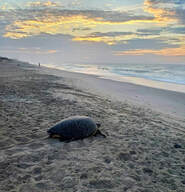 The ladies are in the house – or actually on the beach. After a bit of a late start those turtle moms are finally here and our Topsail Turtle Project volunteers are out at dawn looking for signs of nests. Topsail is pretty much loggerhead territory, but the past few years have seen a green (possibly more than one) take a liking to our sand. Research has shown that our northern loggerheads do not reach maturity until about thirty-five years of age, so these ladies trudging through the sand are good-sized gals, many of them tipping the scales at around three-hundred pounds. They are not built for land travel, so you can imagine the effort involved in hauling yourself through the sand on flippers to find the perfect home for your babies. Believe it or not that’s the easy part! Once mom selects a spot, she digs out a nest about two-feet deep, using only her rear flippers. Then she deposits her clutch of eggs, which average about 100-120 a nest. After carefully filling and packing the nest with sand she uses her powerful flippers to fling sand all around the area to disguise her work. Then it’s the long haul back to the sea where she spends a few weeks of R&R before her next trip ashore. It’s normal for these gals to lay between one and five nests over the course of the summer. Our volunteers verify, mark and record data on every nest. If the nest has been laid in a vulnerable location (below the high tide line or in a high traffic beach area) they carefully remove and relocate every egg to a safer area. Since 2010 we have been participating in a research project at the University of Georgia (http://www.seaturtle.org/nestdb/genetics.shtml) that is tracking the nesting patterns of our northern loggerheads. One egg is harvested from each nest and the DNA and other data is recorded and analyzed. The results are quite interesting and show that sea turtles are indeed mysterious in their nesting habits. Some ladies nested several times in a small area of beach, while others were less discriminating and travelled up and down the eastern seaboard. These critters continue to surprise and amaze those of us who work with them. Although we have numerous eyes on the beach our visitors have always played a critical part in our work. Many times we have gotten calls in the night that “there’s a turtle on the beach.” There are some important things that you can do during nesting season to keep our ladies safe. • Do not harass a nesting turtle in any way. Not only is it illegal but you could cause her so much stress that she abandons the process and loses her eggs. Stay back, do not crowd or chase her or take flash photography. Keep pets away. • Keep beachfront lighting to a minimum. Turtles can become disoriented by bright lights and head off in the wrong direction. With the tremendous growth on the island, especially of massive rental properties even “normal” indoor lighting at night is proving to be a huge distraction to the nesting moms. Every year there are increased instances where mamas (and hatchlings) have gone over the dunes and ended up in parking lots and on the highways. • Do not leave heavy items (chairs, canopies, umbrellas) on the beach overnight. A turtle can become entangled in these. • If you dig a hole do not walk away without replacing all the sand. It’s dangerous not only to turtles but to humans who can stumble into it and break a bone (it’s happened.) Respect the nest and any instructions from our Topsail Turtle Project volunteers. They have all been trained in the proper procedures. We do encourage you to ask them any questions that you might have, however. If you spot a nesting mama, or anything unusual such as an injured or stranded turtle please call our Director of Beach Operations, Terry Meyer at: 910-470-2880. If she is not available, you may call the hospital during operating hours: 910-329-0222 . We will take the information and we will send a trained volunteer to meet you to assess the situation. The State of NC hotline for stranded, sick, and injured turtles is 252-241-7367. The state number picks up 24/7. Please note that all our work with sea turtles, at the hospital and on the beach, is authorized by the NC Wildlife Resources Commission, ES Permit 22ST05. Through June and July we will be open seven days a week: Mon – Fri, Noon-3; Saturday,10-2 and Sunday Noon-2. Tickets MUST be purchased in advance through our website: www.seaturtlehospital.org/visit.html. Select the date, time and the number of guests in your party and purchase your tickets. We limit the number of guests for each time to make the experience more enjoyable and to continue our commitment to keep you and our staff safe as we continue to respond to any changes in Covid. At this point masks are not required. Sorry, but we are not able to accommodate walk-ups for tours once we sell out for the day. Please keep in mind that summer traffic can be very heavy, especially on the weekends so plan your arrival accordingly. If you are coming only to our gift shop (not for a tour) you can enter through the single door to the left of the main entrance. |
Archives
June 2026
Categories |

 RSS Feed

302 Tortuga Lane Surf City, NC 28445 [email protected] | 910-329-0222 SEA TURTLE HOTLINE: 910-329-0222 option 3
|
Quick Links
DONATE
Adopt A Turtle Become an Intern Contact Us Meet our Patients Plan A Visit Sign up for our e-Newsletter Volunteer Teacher Resources SHOP |
Visiting Hours
THE TURTLES WELCOME YOU!
CLICK HERE FOR INFORMATION. ADMISSION (PLUS sales tax & fees): $7.00 General Admission (Ages 13-61) $6.00 Military (Active Duty and Veterans) $6.00 Seniors (Ages 62 and up) $5.00 Children (Ages 3-12) $0.00 Babies and Toddlers (Ages 0-2) (Babies are free but a ticket is still required to save their spot!) |


We are a 501(c)(3) Non-Profit Organization - POWERED BY VOLUNTEERS
EIN: 56-1967579
EIN: 56-1967579
This conservation work for protected sea turtles at the Karen Beasley Sea Turtle Center and on Topsail Island
is authorized by the North Carolina Wildlife Resources Commission, ES Permit 26ST05.